

Is Potato a Sports Food? Part 2
In Part One of this wholesome three part series, I looked into whether the form of your carbohydrate source (solid, gel or liquid) made any difference and set the scene for my investigations. The second question I set out to answer is:
Are sports foods superior to whole food sources of carbohydrate?
This second part therefore investigates the case for using whole food sources to fuel exercise, and how they compare with sports food.
Food First
Look beyond the marketing claims of sports food companies, and you will find that sports nutrition experts and researchers are consistently reminding athletes to focus on a balanced basic diet anchored on ‘real foods‘, and not to overestimate the benefits of dietary supplements. The International Association of Athletics Federations Consensus Statement puts it like this:
‘’a "food first" policy should underpin an Athlete's nutrition plan’’
The Australian Institute of Sport (AIS) also puts out a lot of practical and very well evidenced information from some of the leading sports scientists in the nutrition field. The information is also presented in a very palatable format through their infographics, which are all accessible via their website. I have previously praised their work in my piece on supplements. In the AIS’ Sports Supplement Framework Position Statement, they state that a “food first” approach, which promotes a focus on unprocessed & conventional foods, is a foundation goal of an evidence-based sports nutrition. On each of their infographics, developed to provide information to athletes considering using supplements of all varieties, including sports drinks, bars and gels, they offer whole food bases alternatives to meet carbohydrate needs in suitable circumstances (however, I’d question whether Coke falls under this category, and I don’t think that lolly snakes appear in the wild…):
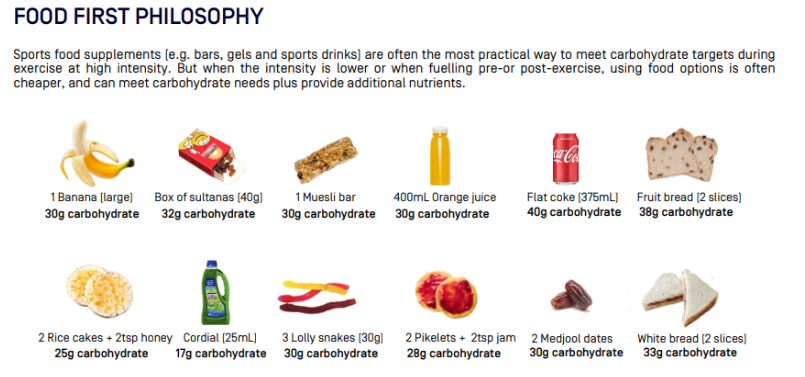
Source: Australian Institute of Sport (AIS)
The benefits of such an approach go beyond simply meeting carbohydrate needs. Other considerations include:
Accessibility: A banana can be found most places in the world. We can’t say the same about your favoured brand of sports gel.
Nutrient Density: Not only do whole foods contain a wider variety of micronutrients, generally in higher quality & quantity, but many of their health benefits are derived from the combination of natural dietary components rather than the individual nutrients.
Expense: All of the examples given here are likely to be a lot cheaper per gram of carbohydrate than any sports food or supplement.
Sustainability: Although some of these foods will come with packaging, there are plastic-free options in many cases. We can also consider the sustainability of sports food in terms of palatability and flavour fatigue. Greater variety in intake (not just downing different flavours of gels) can help combat this.
Health Claims for Sports Drinks
The working definition of ‘Sports Food’, given by the AIS is:
‘‘a food or drink formulated to help people achieve specific nutritional or performance goals by providing a convenient form of general nutrition support of athletes or a targeted use around exercise’’.
Sports food manufacturers will naturally claim that their products are superior in terms of performance outcomes, and according to Rodríguez-Hernández et al. (2023) up to 70% of athletes are highly influenced by the information on the label or advertisements. In their study they evaluated 114 health claims relating to sports drinks in commercial messages such as “maintain endurance level in exercises requiring prolonged endurance” and “improved physical performance during high intensity, high duration physical exercise”. No claim fully conformed with the recommendations. The vast majority indicated an unproven cause–effect and the authors went so far to suggest that these amount to food fraud towards the consumer.
This isn’t to say that sports foods are totally ineffective, but to be wary of the marketing claims. The AIS recognises that some sports foods can play a small but valuable role in an athlete’s diet but their widespread use among athletes is in large part due to the enthusiastic marketing of these products within the sporting environment, and also reflective of the high prevalence of supplement intake in the general community.
‘’Our results support the effective use of potatoes to support race performance for trained cyclists’’
When you think about it, mashed potato is just nature’s carbohydrate gel. And researchers have not just thought about this, but tested its efficacy compared to gels in a controlled experiment setting.
Salvador et al. (2019) give away their findings in their study’s title: ‘‘Potato ingestion is as effective as carbohydrate gels to support prolonged cycling performance’’.
In the experiment they devised, twelve cyclists rode for 120 mins at 60-85% VO2 max before a maximum time trial test. They either ingested 15g of carbohydrate from mashed potato every 15 mins or the equivalent carbohydrate amount from a gel. There was no difference in the time trial performance between the two sources.
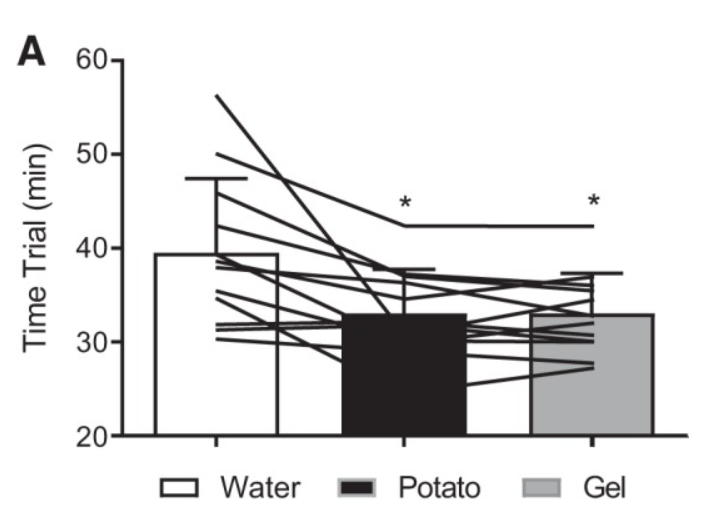
Salvador et al. (2019): Time trial performance as total time (min) for completion
Although the results suggest that potato was equally as effective as the gel, there was more gastrointestinal distress noted in the potato munchers. They put this down to the greater volume involved in the potato as participants had to ingest 128.5g of mashed potato to gain the requisite 15g carbohydrate intake, compared to 23g for the gel. This soon adds up if one is targeting 60g of carbohydrates or more per hour. Additionally, they note that transporting large quantities of mashed potato isn’t particularly practical.
The authors don’t suggest swapping out gels completely for potatoes, rather that whole food sources of carbohydrate can serve as a viable option when exercising, and provide some variety to the routine ingestion of gels during training and competition. Intrinsically, and if you can stomach them, there is no performance difference between potatoes and gels.
Bananas Are Nature’s Sports Food
Bananas are perhaps one of the whole food sources that are most associated with being a fuel for sports. According to Nieman et al. (2012), one medium banana (∼118 g) contains about 27 g carbohydrate (half as sugars), 3.1 g dietary fiber, 105 kcals, and is a good source of potassium and vitamin B6. The sugars are also an almost 1:1 mixture of glucose and fructose, with some additional sucrose. They even come in their own natural packaging (I can never understand why people put a bunch of bananas in another plastic bag in the supermarket 🤷♂️). Therefore bananas appear to be a unique mixture of carbohydrates, nutrients, and antioxidants to provide good fuel for exercise.
There are also numerous research studies that assess banana’s effect on exercise metabolism and performance. The aforementioned Nieman et al. is one of these. They got fourteen trained cyclists to complete two 75km time trials whilst either ingesting an equivalent amount of carbohydrates via bananas or a drink mix. They observed no differences in performance measures, although the banana-munchers did report feeling significantly fuller and more bloated when consuming, which the authors attribute to the higher fibre intake.
As with potatoes, carrying the number of bananas required to fuel prolonged exercise may not always be practical. Nonetheless, the pattern is clear here - they remain an option to replace carbohydrate supplements without posing any detriment to performance.
Similar studies have been carried out on a range of whole food sources, with other popular examples being honey (which has even been subject to a systematic review) and raisins. Again, the consensus is that these foods elicit similar performance, perceptual, and immunological responses compared with other carbohydrate sources (Hills et al., 2019).
Naderi et al. (2023) provide the below illustration of examples of supplementation only, food only, and a combination of the two to provide 90g per hour of carbohydrate during exercise. They summarise the evidence on these whole food sources as:
“Collectively, these studies show that food-based sources such as banana, honey and raisins are excellent alternative CHO sources to be ingested during exercise. They are as effective as commercial-based carbohydrate supplements such as gels and sports drinks to improve prolonged endurance performance”
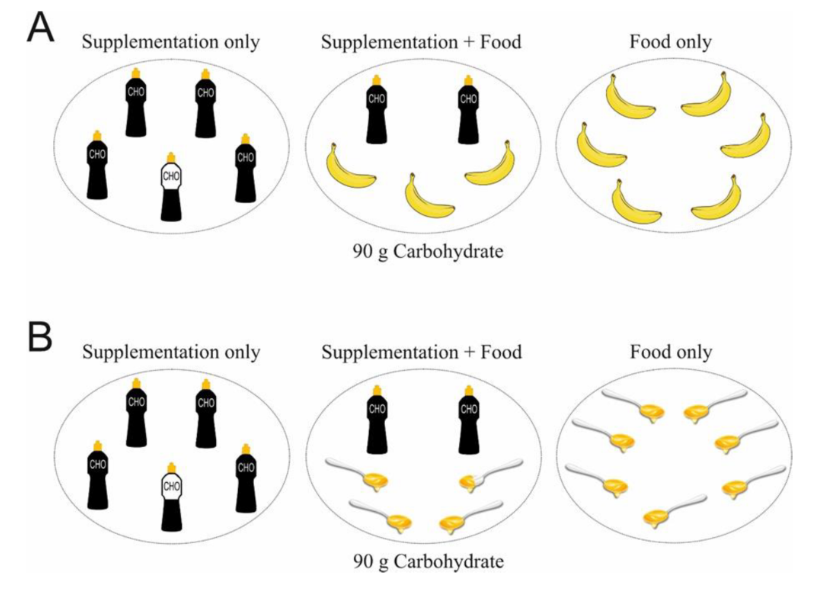
Naderi et al. (2023): Sources of carbohydrate equivalent to 90g per hour.
A Systematic Review
Wrapping up the case for whole foods, what better way than looking at a systematic review. These collect all possible studies related to a given topic, before and reviewing and analysing their results. By combining the data from many different research studies, these can help to resolve discrepancies found in individual studies and improve overall statistical power.
A systematic review by Reynolds et al. (2022) including 15 randomised crossover studies of endurance athletes (14 of which involved cycling) investigated whether there were any differences in performance when consuming carbohydrates from food (fruit, raisins, bars, potatoes, croissants, skimmed milk, rice cakes) or supplements (sports chews, drinks, gels) immediately before or during endurance exercise. The primary outcome was endurance performance, and they also reviewed gastrointestinal symptoms.
There was no difference in performance when using whole food sources of carbohydrate before or during exercise compared to supplemental sources. The only difference noted was that whole foods were slightly more associated with more gastrointestinal symptoms than supplements, particularly with exercise longer than 2 hours.
The observation of a small increase in gastrointestinal symptoms is common among all of the studies I have cited here when the carbohydrate source is solid and if it has to be ingested in larger quantities. One could therefore view this as a drawback of relying too much on solid, whole food sources of carbohydrate. However, it should be noted that these mild symptoms did not affect the performance outcome in the tests and these interventions were likely to have been novel stimuli to the participants. Therefore, repeated exposure of the food during training may increase tolerability and Miall et al. (2018), for example, have demonstrated that even two weeks of ‘gut training’ can improve gastrointestinal symptoms during exercise.
So, if whole foods are so great and consuming them apparently has no detrimental effect on performance then why do sports foods exist at all? A cynic may claim that it’s all in aid of filling the pockets of sports food manufacturers, but there is more to it than that. Part Three will address this.
References
Burke LM, Castell LM, Casa DJ, Close GL, Costa RJS, Desbrow B, Halson SL, Lis DM, Melin AK, Peeling P, Saunders PU, Slater GJ, Sygo J, Witard OC, Bermon S, Stellingwerff T. International Association of Athletics Federations Consensus Statement 2019: Nutrition for Athletics. Int J Sport Nutr Exerc Metab. 2019 Mar 1;29(2):73-84. doi: 10.1123/ijsnem.2019-0065. Epub 2019 Apr 5. PMID: 30952204.
Hills SP, Mitchell P, Wells C, Russell M. Honey Supplementation and Exercise: A Systematic Review. Nutrients. 2019 Jul 12;11(7):1586. doi: 10.3390/nu11071586. PMID: 31336992; PMCID: PMC6683082.
Miall A, Khoo A, Rauch C, Snipe RMJ, Camões-Costa VL, Gibson PR, Costa RJS. Two weeks of repetitive gut-challenge reduce exercise-associated gastrointestinal symptoms and malabsorption. Scand J Med Sci Sports. 2018 Feb;28(2):630-640. doi: 10.1111/sms.12912. Epub 2017 Jun 19. PMID: 28508559.
Naderi, A.; Gobbi, N.; Ali, A.; Berjisian, E.; Hamidvand, A.; Forbes, S.C.; Koozehchian, M.S.; Karayigit, R.; Saunders, B. Carbohydrates and Endurance Exercise: A Narrative Review of a Food First Approach. Nutrients 2023, 15, 1367. https://doi.org/10.3390/nu15061367
Nieman DC, Gillitt ND, Henson DA, Sha W, Shanely RA, Knab AM, Cialdella-Kam L, Jin F. Bananas as an energy source during exercise: a metabolomics approach. PLoS One. 2012;7(5):e37479. doi: 10.1371/journal.pone.0037479. Epub 2012 May 17. PMID: 22616015; PMCID: PMC3355124.
Reynolds KM, Clifford T, Mears SA, James LJ. A Food First Approach to Carbohydrate Supplementation in Endurance Exercise: A Systematic Review. Int J Sport Nutr Exerc Metab. 2022 Mar 1;32(4):296-310. doi: 10.1123/ijsnem.2021-0261. PMID: 35231883.
Rodríguez-Hernández MD, Gil-Izquierdo Á, García CJ, Gabaldón JA, Ferreres F, Giménez-Monzó D, Martínez-Sanz JM. Health Claims for Sports Drinks-Analytical Assessmentaccording to European Food Safety Authority's Scientific Opinion. Nutrients. 2024 Jun 21;16(13):1980. doi: 10.3390/nu16131980. PMID: 38999728; PMCID: PMC11243318.
Salvador AF, McKenna CF, Alamilla RA, Cloud RMT, Keeble AR, Miltko A, Scaroni SE, Beals JW, Ulanov AV, Dilger RN, Bauer LL, Broad EM, Burd NA. Potato ingestion is as effective as carbohydrate gels to support prolonged cycling performance. J Appl Physiol (1985). 2019 Dec 1;127(6):1651-1659. doi: 10.1152/japplphysiol.00567.2019. Epub 2019 Oct 17. PMID: 31622159; PMCID: PMC6962613.