

Is Potato A Sports Food? Part 3
In Part One and Two of this part series, we have established that the form of your carbohydrate source (solid, gel or liquid) doesn’t solely determine oxidation rates and that there is good evidence to suggest that potato is just as effective as gels for fuelling exercise when it comes to performance outcomes alone.
This begs the question as to why sports foods exist at all if mashed potato could do the job equally as well as a gel? That is what this final article in the trilogy sets out to answer, as well as offering some balanced advice on when you may be better off reaching for one or the other.
Food First, Not Food Only
If there are equivalent performance outcomes from whole food sources and sports foods, then why isn’t a ‘food only’ approach employed by all?
Scheck (2025) addresses this matter in their review titled: “'Food First', Not 'Food Only' in Competitive Sports”.
They accept that, in specific situations, a ‘food only‘ strategy may not be an adequate means to provide an athlete with the energy and nutrients needed. It is therefore recommended that they employ a ‘food first‘ strategy which includes the personalised use of certain sports foods and dietary supplements in specific situations, in addition to a balanced whole food based diet. A similar sentiment is shared in the International Association of Athletics Federations Consensus Statement, who state that sports foods may assist an athlete to meet their nutrient targets in scenarios where it is impractical to eat whole foods.
Examples of when a food only strategy may have limitations include:
A shortage of time to prepare and consume bulky, wholesome meals/snacks frequently enough to provide the body with adequate energy and nutrients.
Potential gastrointestinal distress if consuming certain foods shortly before and during exercise of moderate to high intensity.
Meals may be skipped or missed when exercising for long durations.
Specific nutrients can be provided more quickly by sports foods, which is useful when there are less than 24 hours before the beginning of the following vigorous training bout or competition.
Food choices may be limited when traveling, or there may be concerns regarding food hygiene.
It may not be practical to transport large quantities of whole foods if they must be carried on the person.
Sports foods therefore can offer certain advantages such as:
A convenient, lightweight form of fuel that can be accessed easily during exercise.
Durable and are less likely to get squashed or deformed.
Gels and some sports bars are less affected by temperature
Some products are specifically formulated to be a convenient source of other elements such as caffeine, sodium & protein.
Certain sports foods contain multiple transportable carbs (e.g. glucose and fructose) to maximise carbohydrate oxidation at higher intakes (>60g/hr)
A narrative review of a food first approach was also carried out by Naderi et al. (2023), who assess the relative pros and cons:
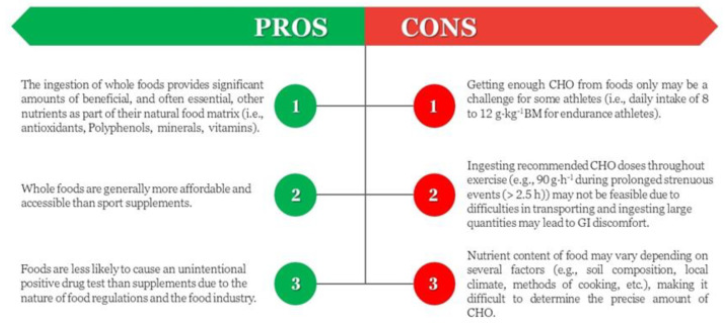
Naderi et al. (2023)
It all comes down to context
As with almost all elements of sport science, there is not one catch-all solution for all athletes here. The right fuel source for the right moment will all depend on the context.
How one fuels a high intensity interval training session during a busy workday at home is going to look very different to resupplying at a remote convenience store during a multi-day self-supported ultra-cycling event. Firstly there are differing carbohydrate requirements, that I introduce in my article on substrate utilisation, and which depend on duration and intensity. Thereafter, given that like-for-like the performance outcomes are observed between whole food and sports food sources, practicalities, preferences and tolerances come to the fore.
Practice also makes perfect here. If you plan to fuel in a certain way during your most important events, this needs to be honed during training. ‘Gut training’ is often cited as a means to improve one’s ability to oxidise exogenous carbohydrates, but the same concept applies to developing tolerances to particular food sources. Again, this need not mean that all high intensity sessions need to be fuelled on potato alone, but if you know you will be taking on a wide range of solid foods during an ultra-cycling event, your longer and lower intensity training sessions should be seen as opportunities to practice event-specific fuelling strategies.
Conclusions
What I hope to have demonstrated through these articles is that claims about superior efficacy of sports foods should be approached sceptically, and that the foundation of a successful athlete’s diet can, and should, be based on whole food sources. Sports foods are the exception, rather than the rule, and largely play a role in meeting nutritional goals when it is impractical to eat whole foods.
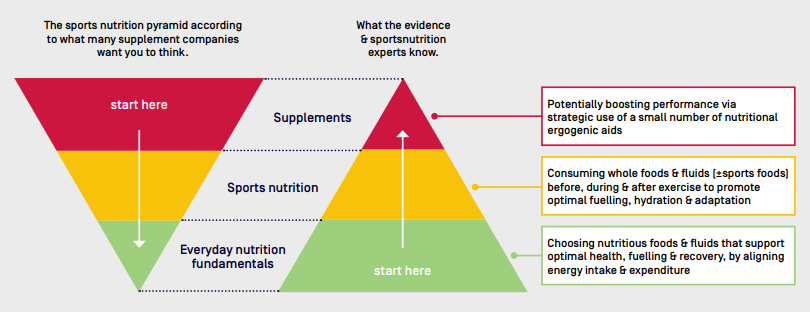
AIS Sports Supplement Framework Position Statement
Even potato fans Salvador et al. (2019) accept that the identification of an optimal feeding strategy is complex and goes beyond simple exercise mode, intensity and duration. Less tangible considerations such as taste, preference and overall convenience will also influence fuel source choice.
In the ultra-cycling space, food can also serve a purpose well beyond being seen simply as fuel. We can’t overlook the emotional component of food, and the pleasure gained from consuming something that we enjoy eating. If this leads to food choices being at times slightly less optimal from a strictly performance or convenience perspective, the net benefit can still be positive if it lifts mood and adds to motivation. Fundamentally, one could fuel solely on liquid sources of a specially formulated mixture containing all macro and micronutent needs. However, would there be much joy in that and would the less tangible downsides outweigh the practical benefits? Meeting energy demands is hugely important but there are many ways this can be gone about and there is not one universal correct answer.
Ultimately, Morton et al. (2026) offer a nice conclusion by advising athletes to adopt a mixed-format approach with the flexibility to select formats according to individual preference, overall nutrition requirements, and conditions or logistics.
References
Burke LM, Castell LM, Casa DJ, Close GL, Costa RJS, Desbrow B, Halson SL, Lis DM, Melin AK, Peeling P, Saunders PU, Slater GJ, Sygo J, Witard OC, Bermon S, Stellingwerff T. International Association of Athletics Federations Consensus Statement 2019: Nutrition for Athletics. Int J Sport Nutr Exerc Metab. 2019 Mar 1;29(2):73-84. doi: 10.1123/ijsnem.2019-0065. Epub 2019 Apr 5. PMID: 30952204.
Naderi, A.; Gobbi, N.; Ali, A.; Berjisian, E.; Hamidvand, A.; Forbes, S.C.; Koozehchian, M.S.; Karayigit, R.; Saunders, B. Carbohydrates and Endurance Exercise: A Narrative Review of a Food First Approach. Nutrients 2023, 15, 1367. https://doi.org/10.3390/nu15061367
Reynolds KM, Clifford T, Mears SA, James LJ. A Food First Approach to Carbohydrate Supplementation in Endurance Exercise: A Systematic Review. Int J Sport Nutr Exerc Metab. 2022 Mar 1;32(4):296-310. doi: 10.1123/ijsnem.2021-0261. PMID: 35231883.
Salvador AF, McKenna CF, Alamilla RA, Cloud RMT, Keeble AR, Miltko A, Scaroni SE, Beals JW, Ulanov AV, Dilger RN, Bauer LL, Broad EM, Burd NA. Potato ingestion is as effective as carbohydrate gels to support prolonged cycling performance. J Appl Physiol (1985). 2019 Dec 1;127(6):1651-1659. doi: 10.1152/japplphysiol.00567.2019. Epub 2019 Oct 17. PMID: 31622159; PMCID: PMC6962613.
Schek, Alexandra. (2025). 'Food First', Not 'Food Only' in Competitive Sports: A Mini-Review. The Open Sports Sciences Journal. 18. 10.2174/011875399X378498250508065801.