

Is Potato a Sports Food? Part 1
I have been told more than once by an athlete that they don’t feel they are fuelling ‘properly’ because they are not using sports foods, instead relying on ‘real’ whole foods during exercise.
Legend has it that I fuel solely from croissants on my multi-day trips, a rumour I will not confirm or deny.
In any case, I have long held a slight scepticim towards the marketing claims of producers of sports food. I mean, how on earth did our hunter-gatherer ancestors survive without a bail-out gel in their pocket to save them from the bonk?!
Sports nutrition has come a long way in recent years, and benefits are being seen not just via improved performance but overall wellbeing, particularly with amateur athletes who I see gaining a huge amount more enjoyment from their sport when they are adequately fuelled. Nevertheless, I do wonder if a more scientific approach to fuelling carries an assumption that this must involve specifically formulated substances that are somewhat better for performance.
Similarly, alongside a wider trend towards seeking marginal gains and short cuts to high performance, the manufacture and marketing of sports supplements has flourished, many spouting claims that are not entirely evidence-based.
Granted, Tour de France riders aren’t chowing down on croissants mid-effort on Alpe d’Huez, but not all of us are riding the Tour de France every day. Still, you will often see bananas sticking out of jersey pockets and, looking at some of the race day menus of the Tour teams, almost the entirety of their pre- and post-race meal plans involve foodstuffs that our grandparents would recognise.
For most forms of exercise, replenishing carbohydrates is the priority as this is the primary substrate utilised for energy production in most situations, and its stores are limited with the human body. How many carbohydrates depends on the context and the individual (which I have addressed here, here and here), but what I am more interested in addressing through this piece is how important the source of carbohydrate is.
I therefore set out to answer two main questions:
Does it matter whether your carbohydrate source is in solid, semisolid (gel) or liquid form?
Are sports foods superior to whole food sources of carbohydrate?
To make the whole thing slightly more digestible, I have broken down my findings into three parts. The first, continued below, addresses the form question, the second gives the case for whole foods as performance enhancers and the final offers some balanced conclusions.
Solid, Semisolid or Liquid
An example of a study that directly compared whether carbohydrate in solid form is as effectively oxidised as carbohydrate in a liquid solution comes from Pfeiffer et al. (2010). Whilst riding for three hours, a group of well-trained cyclists received either a carbohydrate drink or an energy bar plus water (to match the amount of fluid ingested for each). There was also a control trial where the participants only consumed water. The energy bar contained the same amount of carbohydrate as the drink and was low in protein, fat and fibre.
Overall exogenous (from sources external to the body) carbohydrate oxidation rates were not significantly different between the two groups, suggesting that the form in which carbohydrate is ingested did not really matter for the oxidation of the carbohydrate. However, it is important to remember that solid food higher in fat, protein and/or fibre is likely to slow gastric emptying and reduce the delivery of carbohydrates.
Another notable outcome from this study was the perceived stomach fullness that the participants reported after ingesting the various carbohydrate sources. Mean perceived stomach fullness during each hour was significantly higher with the ingestion of the carbohydrate drink than with water alone and was significantly higher with the bar than with both liquid sources. Although no severe GI issues were reported during the trial, the differing levels of perceived fullness illustrate that hunger signals and satiety do not always correspond with energy availability.
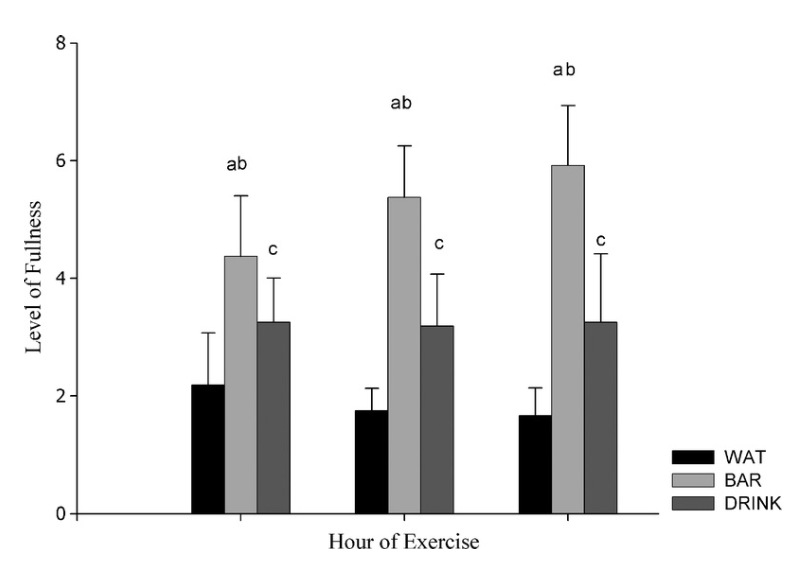
Pfeiffer et al. (2010). Mean perceived stomach fullness during the first, second, and third hours of exercise.
Another study by Hearris et al. (2022) looked at the difference in exogenous carbohydrate oxidation rates between fluid, semisolid and solid sources. Their protocol, illustrated in the image below, involved nine trained males ingesting 120g of carbohydrates per hour from either fluids, a semisolid gel, a solid jelly chew, or a combination of all three. The participants cycled for 180 minutes at 95% of their lactate threshold, followed by a test to exhaustion at 150% of lactate threshold.
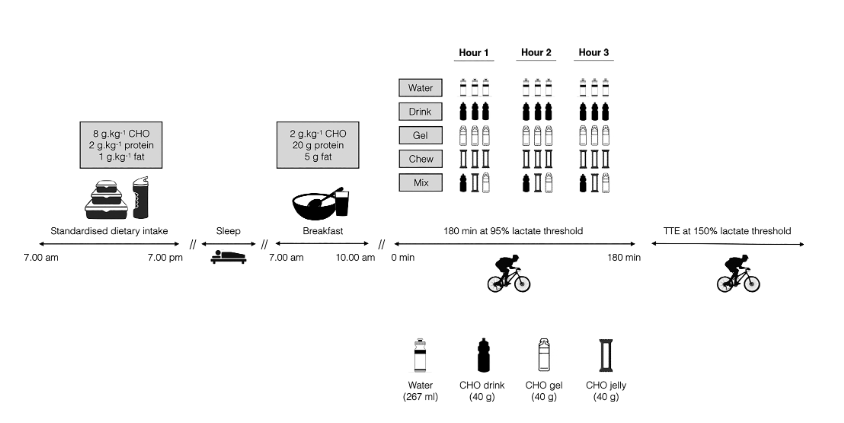
Hearris et al. (2022) study protocol.
They found comparable rates of exogenous carbohydrate oxidation from fluid, semisolid, solid, or a combination of the sources. Despite ingesting such a high intake of 120g per hour, the participants also reported minimal symptoms of gastrointestinal distress across all trials. Exercise capacity was also not significantly different. Although the authors recognise that previous studies have observed greater occurrence of gastrointestinal distress with the ingestion of solid carbohydrate sources, they attribute their findings to the lack of other nutrients such as fat, protein and fibre in the solid chews they used.
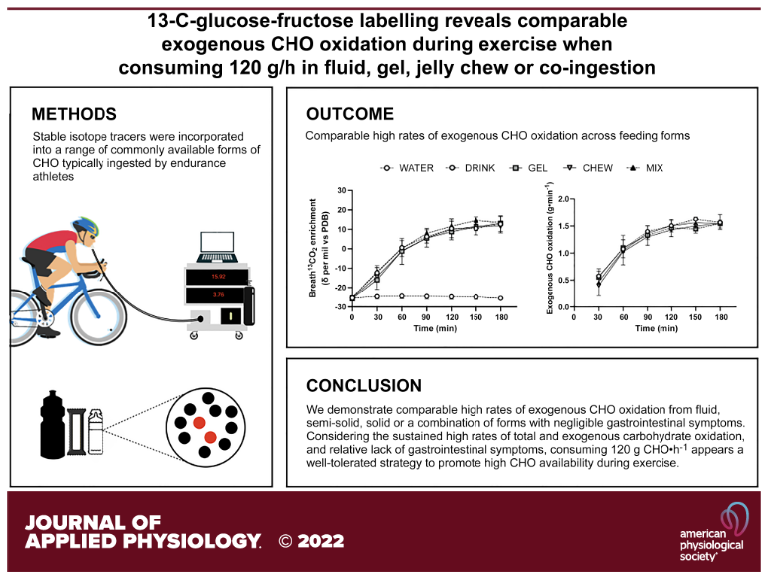
Hearris et al. (2022) study infographic.
These are just two examples, but their findings are representative of the common observation that, in terms of carbohydrate oxidation and performance, there is little difference between liquid, semisolid and solid forms. This is provided that there is little presence of fat, protein or fibre that can slow down gastric emptying. So, all else being equal, our bodies process carbohydrates very similarly whatever the form.
The examples of carbohydrates used within these studies, even for solid forms, still very much fall under the ‘sports food’ category, so I was next interested to see what evidence there was for using whole foods during exercise, especially in terms of performance outcomes. That’s up next.
References
Hearris MA, Pugh JN, Langan-Evans C, Mann SJ, Burke L, Stellingwerff T, Gonzalez JT, Morton JP. 13C-glucose-fructose labeling reveals comparable exogenous CHO oxidation during exercise when consuming 120 g/h in fluid, gel, jelly chew, or coingestion. J Appl Physiol (1985). 2022 Jun 1;132(6):1394-1406. doi: 10.1152/japplphysiol.00091.2022. Epub 2022 Apr 21. PMID: 35446596.
Pfeiffer B, Stellingwerff T, Zaltas E, Jeukendrup AE. Oxidation of solid versus liquid CHO sources during exercise. Med Sci Sports Exerc. 2010 Nov;42(11):2030-7. doi: 10.1249/MSS.0b013e3181e0efc9. PMID: 20404762.