

Grinding to a Halt: Why Declining Cadence Can Ultra-Accelerate Fatigue
For years, researchers have attempted to determine whether there is an optimal cycling cadence for different intensities and durations. To date, results are far from definitive and much of the time it is found that self-selected cadence serves the majority of cyclists best in most situations.
In ultra-cycling endeavors and, to some extent, ‘regular’ extended bouts of cycling during training sessions, I frequently observe athlete’s cadence decline as time goes on. What is not always clear is whether this is detrimental to performance, or just the athlete’s natural response in adjusting their self-selected cadence to the circumstances.
I was therefore interested to review a recent study by Barsumyan et al (2026) who explored cadence decline as a marker of fatigue, potentially offering some insight on these observations and practical strategies to employ.
In this piece I describe the study, summarise the findings and add my interpretation, with some specific takeaways for ultra-cyclists.
Introduction
Cadence is a foundational element of cycling performance and energy management. It reflects the balance between neuromuscular control and metabolic efficiency during sustained efforts.
Cadence is a primary driver of cycling power output, because power is the result of the following simple equation:
Power = Cadence x Torque
When cadence decreases, torque requirements increase to maintain the same power level, potentially accelerating acute muscular fatigue. Optimising cadence is therefore critical for balancing muscular load and cardiovascular effort, ultimately impacting cycling performance.
Athletes typically perform at a cadence they have chosen themselves. This self-selected cadence is at a rate that they personally perceive as the most comfortable and sustainable for the given workload.
A higher cadence (e.g. 90–100 rpm) reduces the torque required for each pedal stroke, spreading the mechanical stress over a greater number of contractions and thus delaying peripheral fatigue. However, this strategy increases cardiovascular strain due to an elevated heart rate and oxygen uptake.
Conversely, a lower cadence (e.g. 70–80 rpm) reduces the metabolic cost, but increases the torque requirements and accelerates acute muscle fatigue
For experienced cyclists, their self-selected cadence is often close to the economical and optimal cadence, minimising acute peripheral muscular fatigue at a given power output regardless of cycling conditions. Changes in cadence over time may consequentially serve as a marker of peripheral fatigue, indicating an imbalance between muscular and metabolic demands.
What did they study?
The researchers hypothesised that cyclists unconsciously adjust their pedalling cadence in an attempt to compensate for acute fatigue as it accumulates during prolonged steady-state exercise.
They expected that athletes would decrease their pedalling cadence with increased acute fatigue and consecutively increase torque per pedal stroke to maintain power output.
Their study aimed to document and analyse the cadence behaviour of trained cyclists during a standardised protocol, exploring whether cadence decline may serve as a marker of acute fatigue-related adaptation and altered performance regulation.
How did they study it?
Seventeen trained male cyclists performed a standardised cycling protocol once per month over a five-month period. The protocol comprised a 10 minute incremental warm-up, increasing from 55% to 65% of the individual’s FTP, followed by a 60-minute steady-state bout at 75% FTP.
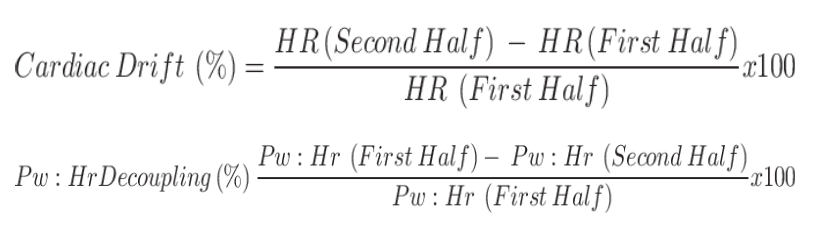
During each test, the researchers recorded heart rate, cadence, power output, cardiacr drift and aerobic (Pw:Hr) decoupling.
Cardiac drift and aerobic (Pw:Hr) decoupling were calculated as follows:
What did they find out?
Cadence declined significantly from the first to the second half of the test, on average from 86.6rpm to 84.8rpm.
Mean cardiovascular drift was found to be 2.09%, and the mean change in aerobic decoupling was found to be comparable at 2.00%. Regression analysis indicated that cadence decline was positively associated with both cardiovascular drift and aerobic decoupling.
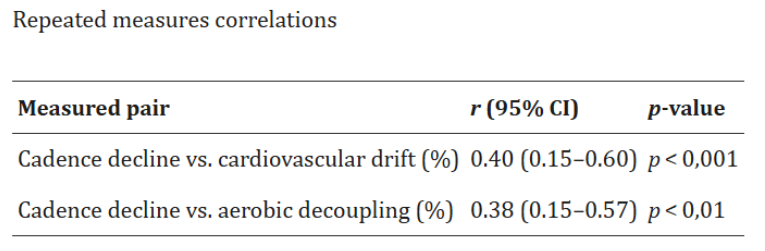
A higher decline in cadence during the second half of the test was thus significantly correlated with both higher cardiovascular drift and higher aerobic decoupling. The correlation is moderate and significant for both relationships.
The linear mixed model revealed a significant positive association between cadence decline, cardiovascular drift and aerobic decoupling:
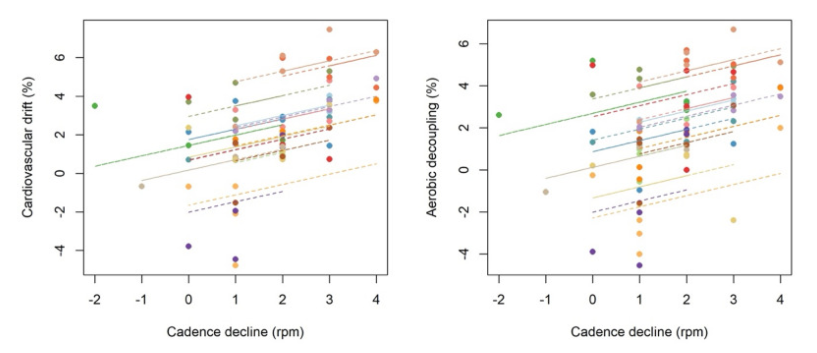
Relationship between cadence decline (rpm) and cardiovascular drift (left) as well as aerobic decoupling (right). Individual regression lines are displayed for each participant.
Specifically, for each additional rpm decrease in cadence (rpm), cardiovascular drift increased on average by 0.61% points. Greater reductions in cadence were systematically related to stronger cardiovascular drift. In addition, a significant positive effect was observed for aerobic decoupling: each additional rpm decrease in cadence was associated with an average increase of 0.58% points in decoupling, suggesting that cadence decline is consistently linked to both cardiovascular drift and aerobic decoupling across athletes.
How did they interpret the findings?
This study shows that even during relatively short efforts cadence tends to decline over time. Most athletes pedal at a higher cadence during the first 30 min of the test compared to the final 30 min.
This decline in cadence, typically ranging from 1 to 5 rpm, suggests that athletes may inadvertently adjust their pedalling rate when acute fatigue develops.
One possible explanation is that the reduction in cadence reflects an unconscious adjustment to pacing or a strategy to reduce perceived exertion rather than being purely a mechanical necessity. Consequently, cyclists may compensate by applying greater force to each pedal stroke in order to maintain the same power output. However, the precise physiological or psychological drivers of cadence reduction remain unclear.
The findings also demonstrate that cyclists’ loss of pedalling cadence in the second half of a 60-minute steady test is associated with the established fatigue markers of cardiovascular drift and power–heart rate decoupling. Athletes who show greater cardiovascular drift also tend to exhibit steeper declines in cadence when the test progresses.
From a physiological perspective, cardiovascular drift reflects progressive cardiovascular strain, which manifests as an increased heart rate and decline in stroke volume at a stable power output. The decline in cadence observed in the second half of an exercise session may represent a fatigue-induced trade-off: as metabolic reserves dwindle and peripheral fatigue accumulates, athletes unconsciously reduce their cadence to mitigate cardiovascular strain. This results in greater torque demands and localised muscle fatigue. These changes signal accumulating physiological stress that may compromise performance and efficiency over time.
Acute fatigue can reduce the efficiency of muscle contractions. A higher force per pedal stroke is thus required despite a stable power output. When fatigue progresses, the focus shifts from metabolic efficiency to strength endurance. The inverse relationship between torque and cadence at a constant power output establishes a biomechanical feedback loop that has significant implications for managing fatigue. Consequently, a reduction in cadence can create a vicious cycle whereby fatigue causes a decline in cadence, thereby increasing torque and accelerating fatigue. This cycle is particularly consequential in events requiring sustained power outputs, where premature cadence shifts could hasten exhaustion.
Despite the associations observed, a decline in cadence alone cannot fully account for the variance in cardiovascular drift or aerobic decoupling. This emphasises the multifactorial nature of fatigue in endurance exercise. Several factors, such as muscle fibre type, pacing strategy, hydration status, and environmental conditions all may independently or interactively influence both cardiovascular and mechanical responses.
These factors suggest that decline in cadence should not be considered as the sole or universal marker of acute fatigue, but rather as one component within a broader, multidimensional framework. A decline in cadence is an immediately observable marker of developing fatigue and may offer a practical tool for real-time assessment of fatigue, in addition to other metrics such as power and heart rate analysis.
Ultra-cycling applications
The observations of declining cadence over time during extended submaximal cycling, and its correlation with the established markers of fatigue, cardiac drift and aerobic decoupling, provide evidence for the link between cadence and fatigue. These findings correspond with what I see in athlete’s data, especially as profound fatigue starts to set in during ultra-cycling endeavours.
As self-selected cadence is generally a subconcious act, changes to cadence as fatigue builds are most likely to indicate an imbalance between the muscular and metabolic demands.
The biggest danger is the vicious cycle that the authors describe, whereby fatigue causes an unconscious decline in cadence, thereby increasing muscular demands and accelerating fatigue. Since decreasing cadence appears to be a subconscious response to fatigue, countering this requires a conscious effort. In contrast to much of the advice about self-selected cadence in ‘normal’ circumstances, ultra-cyclists may benefit from consciously attempting to maintain a higher cadence as fatigue sets in to avoid exacerbating muscular fatigue.
Despite cadence being observed as a marker of fatigue in this study, it cannot account alone for the variance in cardiovascular drift or aerobic decoupling so addressing cadence is not going to be a miracle solution to ward off fatigue. It forms one part of a wider picture, alongside appropriate pacing, fuelling and sleep management when events extend to multiple days.
Declining cadence is likely to be a signal that your body is compensating for compromised metabolic efficiency. Question why this is happening and what you can do to counter this tendency. Is your pace at a sustainable rate? Is your nutrition appropriate? Addressing these two questions is most likely to yield an answer.
TL;DR Summary
Cadence reflects the balance between neuromuscular control and metabolic efficiency.
A higher cadence reduces mechanical stress and thus delays muscular fatigue. However, this increases cardiovascular strain due to an elevated heart rate and oxygen uptake.
A lower cadence reduces the metabolic cost, but increases the torque requirements and accelerates acute muscle fatigue.
Even during relatively short efforts cadence tends to decline over time. Athletes may inadvertently adjust their pedalling rate when acute fatigue develops.
Reduced pedalling cadence in the second half of a 60-minute steady test is associated with two established fatigue markers: cardiovascular drift and power–heart rate decoupling.
The decline in cadence observed in the second half of an exercise session may represent a fatigue-induced trade-off: as metabolic reserves dwindle and peripheral fatigue accumulates, athletes unconsciously reduce their cadence to mitigate cardiovascular strain. This results in greater torque demands and localised muscle fatigue.
Acute fatigue can reduce the efficiency of muscle contractions. A higher force per pedal stroke is required despite a stable power output.
The inverse relationship between torque and cadence at a constant power output establishes a biomechanical feedback loop that has significant implications for managing fatigue. Consequently, a reduction in cadence can create a vicious cycle whereby fatigue causes a decline in cadence, thereby increasing torque and accelerating fatigue.
Despite the associations observed, a decline in cadence alone cannot fully account for the variance in cardiovascular drift or aerobic decoupling - it should be considered as one component within a broader, multidimensional framework.
Reference
Barsumyan A, Soost C, Graw JA, Burchard R. The relationship between cadence decline, cardiovascular drift and aerobic decoupling as a marker of fatigue in well trained cyclists. BMC Sports Sci Med Rehabil. 2026 Apr 2;18(1):179. doi: 10.1186/s13102-026-01678-w. PMID: 41923151; PMCID: PMC13063868.